Sunday, May 1, 2016

Method of Garments Costing for Woven Bottom (Factory Costing)

Introduction:

A garments business is totally stands on order profit. An order profit can be achieved through a proper costing. A proper costing can be done by using a proper garments costing method. So, ultimately, garments costing method is the heart ofreadymade garments business. To make an accurate costing of an order, today I will discuss about the method of garments costing for woven bottom.

Method of Garments Costing for Woven Bottom (Factory Costing):

Before starting of a woven bottom costing, a woven garments merchandiser should confirm the following matters:
  1. Fabric Cost,
  2. Embroidery Cost,
  3. Printing Cost,
  4. Cost of Making (CM),
  5. Washing Cost,
  6. Accessories Cost,
  7. Commercial Cost,
  8. Others Cost.
Important tips***
  • The very next duty of a woven garments merchandiser is to determine the fabric consumption and costing.
  • After fabric consumption and costing, all the others necessary cost should be added with fabric cost to achieve total cost of a garment.
To clear all the confusion about the above discussion, now I will present an example for woven bottom costing in the below.

Example:

Suppose,
The Buyer “Metro-Tex” forwards a “Woven Denim Bottom” item order to you with the following specification.

Follow the below measurement chart.

Actual Length in (inch)
Sewing Allowance
Measurement with Sewing Allowance
Total Length including Waist Height
46”
2”
48”
Waist Width
37”
2”
39”
HIP
43”
2”
45”
Thigh
20”
2”
22”
Bottom Width
14”
2”
16”
Back Pocket Length
8”
1”
9”
Back Pocket Width
7”
1”
8”
Belt Loop Length
1.5”
0.5”
2”
Belt Loop Width
0.5”
0.5”
1”
Pocket Bag Length
8”
1”
9”
Pocket Bag Width
7”
1”
8”
Now, determine the garments costing (on FOB) for the above order.

Solution:

Fabric width – 58”
(Here, the given fabric width is 58”, during sewing, we cannot use the edge of a fabric. So, all time we must exclude 1” from the given fabric width. So, now the fabric width is 58-1 = 57”)
Wastage – 10%
Let,
  1. Fabric Cost per yds- $3.70
  2. Printing Cost per dozen- $1.40
  3. Embroidery Cost per dozen- $3.80
  4. Accessories Cost per dozen- $1.70
  5. Washing Cost per pcs- $2.00 so, washing cost per dozen is – ($2.00 × 12) = $24.00
Now, we have to calculate the fabric consumption for the above order.
1. Fabric consumption for the Body Parts:
Here, we will apply the following formula (Per dozen),

Now,
Body Width,
= 1/2 Thigh with sewing allowance
= 22
Now, from equation (A), we get-

= 24.70yds per dozen………………………………………………… (B)
So, fabrics needed for the body parts is 24.70yds per dozen.
2. Fabric consumption for the Back Pocket (2pcs):
Here, we will apply the following formula (Per dozen),

= 1.68yds per dozen………………………………………………………………..(C)
So, fabrics needed for the back pocket is 1.68yds per dozen.
3. Fabric consumption for the Pocket Bag (2pcs):
Here, we will apply the following formula (Per dozen),

= 3.37yds per dozen……………………………………………… (D)
So, fabrics needed for the pocket bag is 3.37yds per dozen.
4. Fabric consumption for the Belt Loop (5pcs):
Here, we will apply the following formula (Per dozen),

= 0.12yds per dozen……………………………………………. (E)
So, fabrics needed for the belt loop is 0.12yds per dozen.
Now,
By adding the equation B, C, D and E we can achieve the total fabrics consumption for the above order (per dozen)-
= (B +C + D + E) yds per dozen
= (24.70 + 1.68 + 3.37 + 0.12) yds per dozen.
= 29.87yds per dozen.
So, total fabric consumption for the above order is 29.87yds per dozen.
As, fabric cost per yds is $3.70 then, total fabric cost per dozen is (29.87yds × $3.70) = $110.52
Now,
By adding all the following costs with total fabric cost, we will get the total FOB cost of garments per dozen.
Fabric cost per dozen ………………………… $110.52 ……………………. (H)
Printing Cost per dozen ………………………$1.40 ……………….………… (I)
Embroidery Cost per dozen ………………… $3.80 …………………………. (J)
Accessories Cost per dozen …………………..$1.70 …………….…………… (K)
Washing cost per dozen ……………………… $24.00………………………… (L)
Cost of making (CM)…………………………… $5.00 …………..…………….. (M)
Commercial cost ………………………….……. $0.60 ………………………….. (N)
Others cost ………………………………….……. $0.20 ………………………….. (O)
So,
Total FOB cost per dozen = (H + I + J + K + L+ M + N + O)
= $ (110.52 + 1.40 + 3.80 + 1.70 + 24.00 + 5.00 + 0.60 + 0.20)
= $147.22 per dozen.
In case of factory, we received the order from a buying hose (Here, we got the order from Metro-Tex Buying House), so we have to pay 7%commission to them for that order.
So, in this situation, total FOB cost per dozen stands at-= $147.22 per dozen + 7% commission
= $157.53 per dozen.
In factory costing, profit% for the factory (here-10%) should be added with total FOB cost per dozen.
So,
Total FOB cost per dozen with profit% stands at-=$157.53 + 10% profit
= $173.28
Now, total FOB cost per pcs is ($173.28 / 12) = $14.44
So, factory cost (FOB) per pcs garment is $14.44

9 Key Points of Garment Specification Sheet

Introduction:

Garments specification sheet is an important document for manufacturing any garments. The main objects of providing garments spec sheet to the manufacturer is to facilitate the whole processes of garments manufacturing. As its importance in readymade garments sector, today I will present here a details discussion about the garments specification sheet.

Garments Spec Sheet Used in Apparel Industry:

Definition of Garments Specification Sheet:

Garments specification sheet is a document of a product which contains the sketch of garment design, fabric construction etc. It is provided by the buyer to the garment merchandisers at the beginning of a garment export order. Garment merchandisers normally receive garments specification sheet in soft copy (PDF file) from the buyer.
Garments Specification Sheet
By following this document, garment merchandiser can run the others merchandising procedure of that product such as consumption, costing etc. It should be noted here that, garments specification sheet can be corrected after developing sample. In RMG sector, it is also known as garments spec sheet, specification sheet or garment spec.

Key Points of a Garments Spec Sheet:

Normally garments specification sheet contains the following key points:
  1. Sketch or design of the product,
  2. Measurement chart,
  3. Printing instruction,
  4. Embroidery instruction,
  5. Stitch instruction,
  6. Garments washing instruction,
  7. Accessories instruction,
  8. Different label instruction,
  9. Necessary comments related to the product.
All the above key points have discussed in the below:

1. Sketch or design of the product:

Sketch or design means the basic outlook of the required item. It is confirmed by the buyer. He can make it by using computer.

2. Measurement chart:

Measurement chart or measurement sheet contains various size measurement of the required item. By following this sheet pattern has to develop.

3. Printing instruction:

Printing instruction contains various information about the required print for the item. Printing instruction means print size, print location etc.

4. Embroidery instruction:

Embroidery instruction contains different types of information about the required embroidery for the definite item. Embroidery instruction means embroidery size, embroidery location etc.

5. Stitch instruction:

Stitch instruction contains various info about the stitch required for the item. Stitch instruction means stitch type, stitch thread types etc.

6. Garments washing instruction:

Sometimes garment has needed various wash effects which is instructed here. Garments washing instruction means types of wash, softness, hardness etc.

7. Accessories instruction:

Accessories instruction contains different information about the required types of accessories needed for the garment.

8. Different label instruction:

Label instruction contains various types of label such as main label, care label, size label etc.

9. Necessary comments related to the product:

If buyers seemed to deliver some comments related to the required garments manufacturing methods then he can use this option.

GSM Calculation Method Without Using GSM Cutter

Introduction:

Normally a garments merchandiser does not follow the fabric manufacturing systems. Apparel merchandiser ordered the knitting section by providing the required instructions (Fabric type, GSM) given by the buyer. As a result, merchandiser can’t give surety about the contained fabric GSM. If merchandiser will follow some GSM calculation method, can easily identify the correct fabric GSM. As its importance in garments merchandising today I will present GSM calculation method in this article.
GSM Calculation method without using GSM Cutter
As a garments merchandiser everyone have to know about the GSM calculation method. GSM can be calculated by using GSM cutter or sometimes without using GSM cutter.

GSM:

GSM means gram per square meter. Its unit is (gm/m2). In knitting fabric it is the main parameter. It is controlled by loop length. If loop length increases GSM will decrease and vice versa.

GSM Cutter:

GSM cutter is one kinds of circular cutter, which cuts 1/100 of a square meter of fabric area.

GSM Calculation Method without Using GSM Cutter:

During calculating fabric GSM without using any GSM cutter, we should follow the following steps:
  1. At first, cut 5pcs (12cm × 12cm) fabric sample from the different portion of fabric. (Here 12cm is in length and 12cm is in width).
  2. Measure the weight of each sample in one by one method.
  3. Now, calculate the average weight of fabric sample.
  4. Also calculate the fabric sample area by multiplying length and width.
  5. Now by putting “average sample weight” and “fabric sample area” in the following formula, we can get easily the fabric GSM.
GSM calculation formula (in case of without using GSM cutter),gsm

Example:

Suppose,
5pcs (12cm × 12cm) size fabric sample weights are 1.8gm, 2gm, 1.85gm, 1.90gm and 1.95gm respectively.
Now,
Average weight of (12cm × 12cm) size fabric sample is,
= 1.9gm
And,
Sample fabric area = fabric sample length × fabric sample width
= (12 × 12)
= 144cm2
Now,
GSM (in case of without using GSM cutter),

= 131.94
So, fabric GSM is 131.94

How to Calculate Fabric GSM Using GSM Cutter

Introduction:

Fabric GSM plays an important role in garments manufacturing sector. As a garments merchandiser everyone have to know about the fabric GSM calculation method. It should be noted here that, fabric GSM can be calculated by using GSM cutter or sometimes without using GSM cutter. Here, I have presented the fabric GSM calculation method by using GSM cutter.

Fabric GSM Calculation

GSM:

The meaning of GSM is “gram per square meter”, which unit is (gm/m2).

GSM Cutter:

GSM cutter is a circular cutter. GSM cutter cuts 1/100 of a square meter of fabric area.

GSM Calculation Method Using GSM Cutter:

GSM calculation method using GSM cutter is not same as we have followed during GSM calculation method without using GSM cutter. Here, we should follow the below steps:
  1. Firstly, you have to cut 5pcs swatches by sing GSM cutter from the different parts of fabric.
  2. Now, Measure the weight of each cutting swatches with the help of weighing balance in one by one method.
  3. Calculate the average weight of cutting swatches.
  4. Now, by multiplying “average cutting swatch weight” with 100, we can easily get the actual fabric GSM.
Note: Area of round GSM cutter is (1/100) m2
Now, one example is enough to clear the above discussion which has given in the following.

Example:

Suppose,
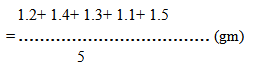
5 pcs cutting swatches weights are 1.2gm, 1.4gm, 1.3gm, 1.1gm and 1.5gm respectively.
Now,
Average weight of cutting swatch,

= 1.3gm
In this situation, we have to multiply average cutting swatch weight by 100 to get actual fabric GSM.
So,
Fabric GSM = Average cutting swatch weight × 100
= 1.3 × 100
= 130
So, fabric GSM by using GSM cutter is 130